Top, Professional and Reliable Manufacturer of Various Machinery – YG Machinery
Shotcrete Robot
wet shotcrete robot
concrete shotcrete robot
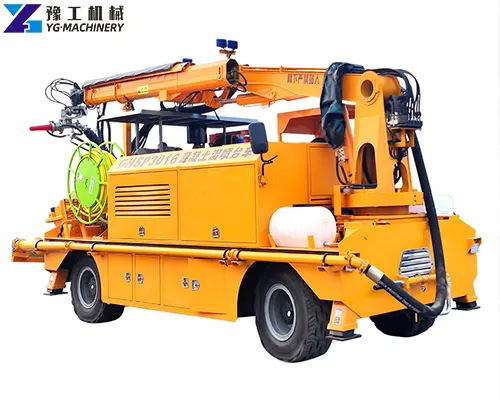
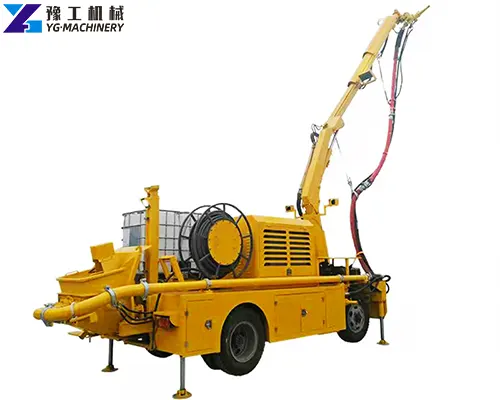
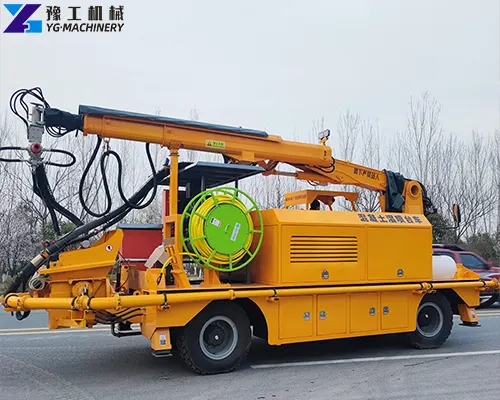
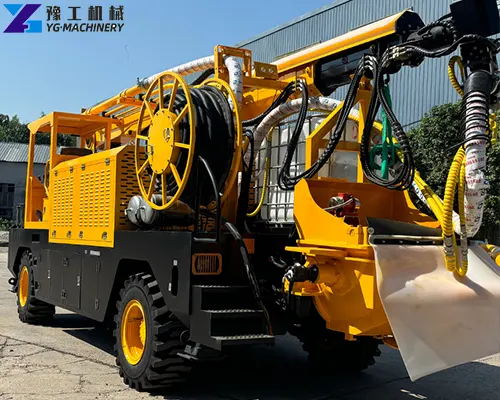
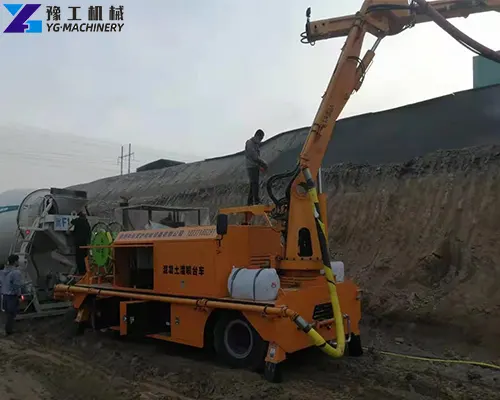
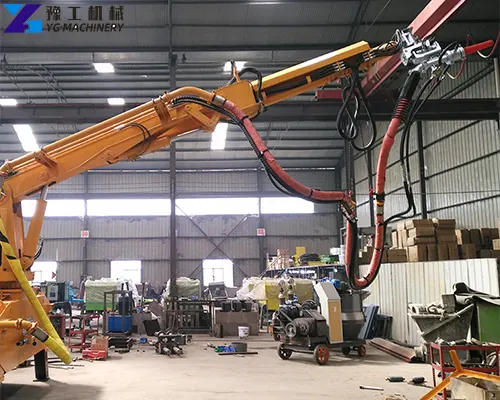
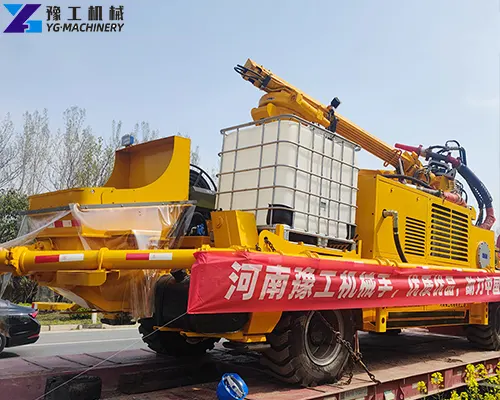
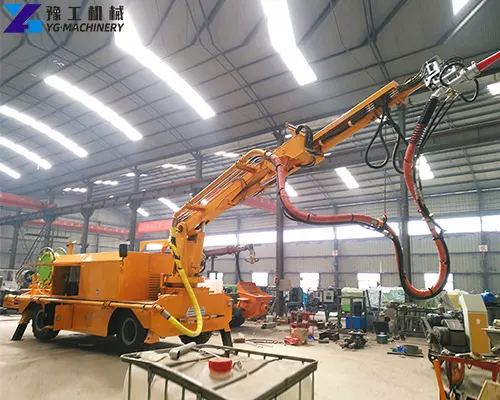
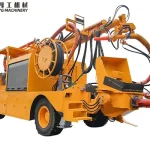
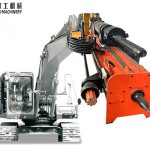
A shotcrete robot, often referred to in the industry as a robotic shotcrete machine or an arm robotic shotcrete machine, is a high-end automated construction device that integrates walking, pumping, and spraying. It completely solves the quality fluctuations and management problems associated with manual labor, representing an upgrade trend in underground engineering support.
This equipment belongs to the high-end wet shotcrete machine category and is currently sold in bulk to countries with rapid mining and infrastructure development, such as Peru, Chile, Indonesia, South Africa, and Australia. It is widely adaptable to high-standard support scenarios such as tunnels, mines, and foundation pits. If your project also wants to reduce labor costs, then it’s time to consider YG’s shotcrete robot.
Case Studies of Customers in Australia and India Using YG Shotcrete Robot Equipment
Case Study 1: Deep Shaft Support at a Gold Mine in Western Australia
Client Background: A large gold mine in the Pilbara region of Western Australia, with a deep ore body and a maximum mining depth exceeding 1000 meters. The deep tunnels experience high temperatures (exceeding 35°C locally), significant ground pressure, and poor surrounding rock stability, requiring rapid shotcrete support after each blast. Previously, the mine used manual shotcrete, with four operators working in two shifts, each shift spraying approximately 30 cubic meters, with a rebound rate of about 20%.
Solution: The mine purchased a wet shotcrete system equipped with a 13-meter boom and a robotic shotcrete machine, along with a 55 kW air compressor and an automatic additive metering device. The equipment uses a dual-power configuration of diesel and electric; diesel is used underground, and electric power is switched during surface transport to reduce operating costs. Operators complete the spraying via a wireless remote control handle at the tunnel entrance, eliminating the need to enter the high-dust working face area.
Usage Results: After its introduction, the single-shift spraying volume increased to 55 cubic meters, the rebound rate decreased to 9%, and approximately 3.5 tons of concrete were saved daily. The spraying team was reduced from 4 people to 2 (1 operator + 1 assistant), reducing labor costs by 55%. The incidence of respiratory diseases among workers operating in high-dust areas was reduced to zero, and the mine successfully passed the inspection of the Australian Mine Safety Inspection Service (DMIRS).
Customer Testimonial: “This shotcrete robot performed stably under the extreme conditions of a kilometer-deep well. The equipment uptime exceeded 95%, providing reliable assurance for our continuous deep mining operations.” — Equipment Director of the gold mine (Western Australia)
Customer Case Two: A Metro Tunnel Project in India
Customer Background: A metro extension project under construction in Bangalore, India, includes 3 double-track shield tunnels with a total length of approximately 12 kilometers. The tunnel diameter is 6.3 meters, traversing granite residual soil strata with localized water abundance. Located in an urban built-up area, the project faces stringent ground settlement control standards, requiring the construction team to ensure the quality of simultaneous support while rapidly excavating.
Key challenges included: a shortage of skilled shotcrete operators in the Indian construction market, making the recruitment of foreign operators extremely costly; and the requirement for a surface flatness error of no more than ±10 mm for the shotcrete layer in subway tunnels, which was difficult to consistently achieve manually. Furthermore, the project’s location in a tropical monsoon climate zone limited the construction window during the rainy season (June-September), necessitating the construction team to maximize shotcrete output within a limited timeframe.
Solution: The construction team introduced two wet shotcrete machines equipped with 10-meter booms, utilizing wheeled chassis and a compact design to adapt to the limited space of the shield tunnel. During shotcrete, the robotic arms, in conjunction with a total station, monitored the shotcrete thickness in real time, automatically adjusting the boom posture and shotcrete volume. A spray dust suppression system reduced the risk of surface crusting under high humidity conditions during the rainy season.
Usage Results: The two machines operated in tandem, achieving an average daily shotcrete volume of 180 cubic meters, 2.5 times the efficiency of manual labor. The shotcrete surface smoothness pass rate reached 96%, exceeding the owner’s 90% acceptance standard. This resulted in an approximately 15% increase in tunnel boring speed, and the overall project schedule was completed two months ahead of schedule.
Client Testimonial: “Recruiting a sufficient number of skilled shotcrete operators in the Indian construction market is nearly impossible. The robotic shotcrete machine completely freed us from reliance on manual labor, and both the shotcrete quality and schedule exceeded expectations.” — Project Chief Engineer (Bangalore, India)
Before Purchasing a Shotcrete Robot, You Need to Consider These 5 Things
1. What model of shotcrete robot is suitable for small-section tunnels?
Not all projects require the longest boom model. For small-to-medium-section projects with tunnel clearance widths less than 5 meters, prioritize compact short-boom models (boom span 7-9 meters), keeping the overall width under 2.1 meters and the minimum turning radius around 7 meters, allowing for flexible maneuvering in confined spaces. Choosing an oversized model will restrict its deployment, while choosing an undersized model will prevent it from covering the tunnel arch. When contacting YG Machinery, provide the specific tunnel cross-section dimensions so the technical team can provide a precise recommendation.
2. Wet spraying versus dry spraying: which is more suitable?
Global market trends show that wet spraying for wet mix shotcrete machines accounts for approximately 70% of the new market share. Wet spraying has a much lower rebound rate (10-15%) than dry spraying (25-40%), resulting in a higher spray layer intensity and less dust at the work site. Dry shotcrete is primarily suitable for situations requiring emergency repairs, where there is no ready-mixed concrete supply on site, or where special dry mix formulations need to be addressed. If your project has a stable concrete supply, wet shotcrete is the preferred choice.
3. What if the vehicle is too large to fit through the construction site gate?
Be sure to confirm the equipment’s transport dimensions before purchasing. The standard transport width for the entire machine is typically 2.1-2.5 meters, height 2.8-3.2 meters, and length 6-8 meters. Confirm the clearance dimensions of the site access roads, tunnels, and tunnel clearances to ensure the equipment can smoothly enter the work area. If the dimensions are critical, consider disassembly or segmented transport. Some compact models have detachable booms to meet special transport restrictions.
4. Can the equipment operate normally underground without power?
Yes. Choose an arm robotic shotcrete machine equipped with a diesel engine. For underground operations, models meeting explosion-proof certification standards are recommended. For surface operations or short-distance transport, a diesel + electric dual-power system can be selected: diesel is used underground, and the electric mode is switched when entering an area with electricity, resulting in lower operating costs. Some mining projects require equipment to meet specific explosion-proof ratings (such as Ex d I/IIC); specifications must be confirmed with YG Machinery before procurement.
5. How long does equipment operation training take? How difficult is it to learn?
YG Machinery provides 2-5 days of on-site training upon equipment delivery, covering boom operation, pump control, daily maintenance, and safety procedures. Personnel with experience operating excavators, loaders, and other construction machinery can learn faster, typically operating independently within one week. Remote video training and operation manuals are also provided to help operators learn in advance before the equipment arrives on site.
Frequently Asked Questions about YG Shotcrete Robot
Q1: What’s the difference between this equipment and a regular wet shotcrete machine?
A1: Regular wet shotcrete machines require manual operation of the nozzles, and the quality is greatly affected by the worker’s experience. The shotcrete robot can automatically scan and plan the path, ensuring precise spray thickness, stable quality, and traceable data. It’s a more advanced, intelligent device.
Q2: Can it operate completely unmanned?
A2: In fully automatic mode, it can autonomously complete the shotcrete operation. One person is still needed for remote safety monitoring on-site, eliminating the need for close-range operation and significantly reducing personnel requirements.
Q3: Can the explosion-proof version be used in underground mines?
A3: Yes, we offer explosion-proof modification options for mining. The electrical system is explosion-proof, meeting safety standards for high-gas, coal mine, and other high-risk underground environments.
Q4: Is it difficult to operate, and how long does it take to learn?
A4: The system interface is simple and supports semi-automatic auxiliary operation. Ordinary operators can become proficient in 1-3 days of training, and the fully automatic mode is even faster to learn.
Q5: Can the construction data be integrated with a project management system?
A5: Yes, it supports standard data interfaces and can be integrated with BIM systems and project management platforms to automatically synchronize construction progress and quality data.
Q6: Are they easily replaceable parts?
A6: Very easy. Easily replaceable parts such as nozzles and seals are modularly designed, highly versatile, and can be completed in 10 minutes.