Top, Professional and Reliable Manufacturer of Various Machinery – YG Machinery
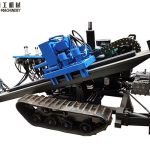
Robotic Shotcrete Machine
robotic shotcrete spraying equipment for sale
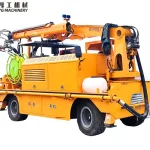
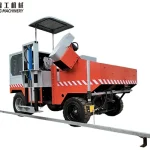
engineering truck-mounted robot shotcrete machine
In tunnel construction, mining excavation, and underground engineering, shotcrete is a core process for reinforcing surrounding rock and forming support structures. Traditional manual shotcrete relies on workers holding spray guns, resulting in high labor intensity, a high rebound rate, and a dusty working environment, exposing workers to harmful conditions for extended periods. The emergence of robotic shotcrete machines (also known as boom-type wet shotcrete machines) has fundamentally changed this situation.
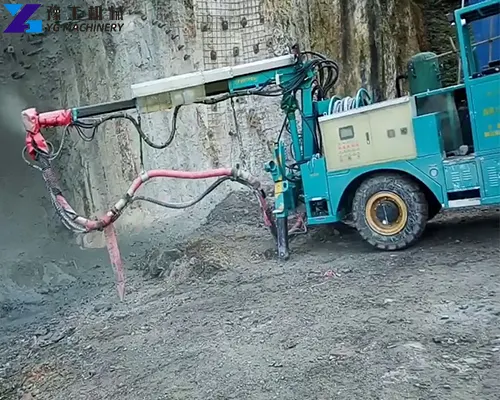
A wet mix shotcrete machine equipped with a hydraulic robotic arm allows operators to perform precise shotcrete from a safe distance, increasing efficiency by more than double compared to manual methods, reducing rebound rate by 30-40%, and significantly reducing safety risks for construction workers. In the past five years, with the surge in global tunnel construction and increasingly stringent construction safety regulations, shotcrete robots have become standard equipment in mining and tunnel projects.
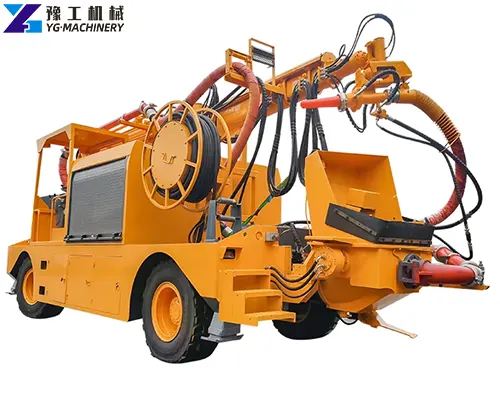
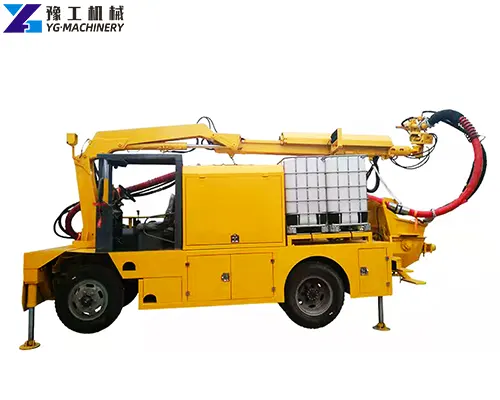
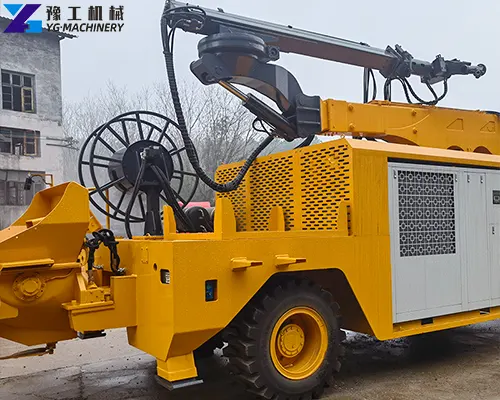
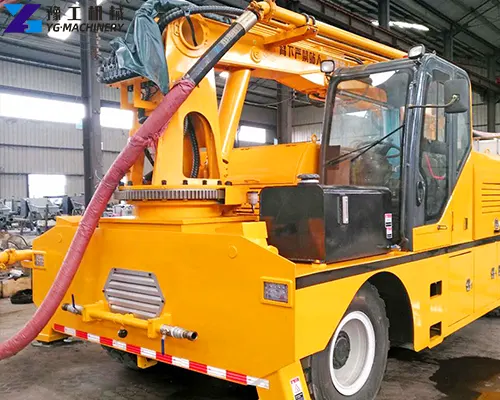
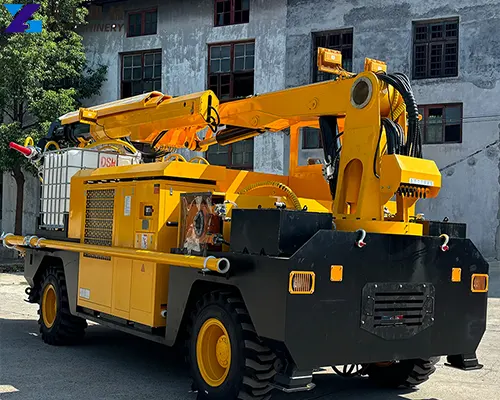
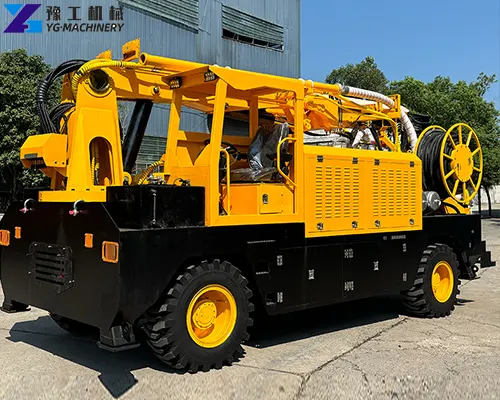
A robotic shotcrete machine is a concrete shotcrete device mounted on a self-propelled chassis, equipped with a hydraulic robotic arm and nozzle capable of multi-degree-of-freedom movement, replacing traditional manual shotcrete operations. Users often refer to them as shotcrete robots, concrete spraying robots, or wet shotcrete machines. They are used in mines for tunnel support and in building repairs for structural reinforcement. If your project also requires a concrete spraying robot, please contact us now for more product information.
buy concrete spray shotcrete system with robotic arm
6 Core Functions of a Robotic Shotcrete Machine
Function 1: Remote Control Operation, Significantly Reducing Safety Risks
Operators control the entire spraying process from a safe distance (typically 5-15 meters) via a remote control handle or in-cabin console, completely avoiding the high-pressure rebound and dust areas in front of the nozzle. This is the core value of a robotic shotcrete machine compared to manual spraying—reducing the risk of on-site injuries by over 40%, especially in high-gas mines and tunnels with weak surrounding rock, where this advantage directly impacts the safety of construction workers.
Function 2: Multi-DOF Boom, Achieving Precise Spraying Without Blind Spots
Hydraulic robotic arms typically offer 4-6 degrees of freedom: boom extension, boom rotation, boom pitch, forearm pitch, and nozzle rotation. This means that a robotic shotcrete machine can cover every corner of the tunnel cross-section—the top, sidewalls, bottom corners, and arches—maintaining the optimal spray angle at all times, resulting in significantly higher concrete density and adhesion strength compared to manual handheld spray gun operations.
Function 3: Wet Shotcrete Process, Rebound Rate Below 10%
Compared to dry shotcrete, the pre-mixed concrete in a wet mix shotcrete machine is fully moistened before pumping, requiring only a small amount of compressed air and accelerator at the nozzle. The rebound rate of wet shotcrete is typically controlled within 10-15%, while the rebound rate of traditional dry shotcrete is as high as 25-40%. Every percentage point reduction in rebound directly translates to a corresponding saving in concrete material costs.
Function 4: High-Pressure Pumping, Stable and Continuous Supply
The concrete pumping system maintains a stable pumping pressure (typically 7-23 MPa), ensuring continuous concrete flow during shotcreting. The “interruption” or “pulsation” phenomena common in traditional manual shotcreting are eliminated, resulting in a smoother sprayed surface and more uniform thickness. Some models support constant pressure pumping mode, maintaining stable shotcrete quality even during long-distance pipeline transport.
Function 5: Compact Design, Suitable for Narrow Tunnel Cross-Sections
Many wet shotcrete machine models feature a compact chassis design to meet the needs of small and medium-sized tunnel projects. The overall width can be controlled within 2.1 meters, with a minimum turning radius of approximately 7 meters, enabling flexible maneuvering in confined spaces. The matching small boom (such as the HSC-2008 series) is optimized for small-section tunnels and is suitable for short-distance spraying operations in mining roadways and urban subway construction.
Function 6: Rapid Relocation, Adaptable to Various Construction Scenarios
Equipped with four-wheel drive and a hydraulic support boom, the robotic shotcrete machine can be quickly moved and positioned on the construction site. When changing sites, the entire machine can be transported by a mining truck, a truck, or a flatbed truck. Some models offer multiple power options (diesel/electric/air compressor) to flexibly adapt to the energy conditions of different construction sites.
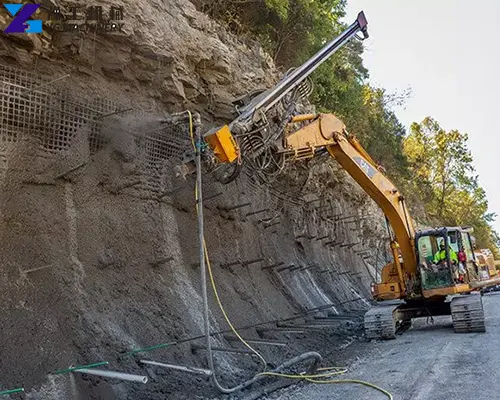
Mining and Tunnel Support: This is currently the largest application market. In tunneling in metal, coal, and non-metal mines, shotcrete is used to quickly seal surrounding rock and control ground pressure, a crucial process for ensuring operational safety. Approximately 52% of mining projects have shotcrete robots as standard equipment.
Railway and Highway Tunnel Construction: In urban subways, mountain tunnels, and hydraulic tunnels, shotcrete forms initial support before secondary lining is applied. Approximately 37% of tunnel projects use shotcrete robots, especially in sections with weak surrounding rock. Robots can complete shotcreting near unstable working faces, preventing personnel from entering hazardous areas.
Hydropower Engineering: Concrete support for hydropower station water diversion tunnels, pressure pipelines, and underground powerhouses requires high-strength, uniformly thick shotcrete layers. Large wet shotcrete machines are used in hydropower projects for continuous shotcreting operations over large cross-sections and long distances.
Hydropower Engineering: Building Structure Repair and Reinforcement — In the structural reinforcement of old buildings, bridge piers, and historical sites, shotcrete provides a high-bond-strength repair layer. The precise control capabilities of shotcrete robots make them superior to traditional manual plastering in repair projects.
Underground Utility Tunnels and Integrated Utility Tunnels: In the construction of urban underground integrated utility tunnels, where space is limited and manual operation is restricted, shotcrete robots can flexibly enter the tunnel interior to complete the support spraying.
Border and Military Defense Engineering: In special engineering fields requiring the rapid construction of protective structures and civil defense projects, the efficient spraying capabilities offered by robotic shotcrete machines are highly valued.
Artistic Design and Complex Concrete Structures: In recent years, shotcrete robots, due to their precise trajectory control capabilities, have begun to be applied to the shotcrete molding of swimming pools, irregularly shaped buildings, and art sculptures, showcasing new possibilities in the field of arts and crafts.
Frequently Asked Questions About Robotic Shotcrete Machines
Q1: How much more efficient is it compared to manual shotcrete?
A1: The efficiency of a robotic shotcrete machine is typically 2-3 times that of manual shotcrete. A standard machine can spray 20-40 cubic meters per hour, while a 3-person manual shotcrete team can usually only complete 8-15 cubic meters per hour. Furthermore, the machine has strong continuous operation capabilities, is unaffected by fatigue, and can extend effective working time.
Q2: Can this equipment be used in mines with temperatures above 45 degrees Celsius?
A2: Yes. The highly protective wet shotcrete machine is equipped with high-temperature-resistant hydraulic oil and a reinforced cooling system, allowing it to operate continuously in ambient temperatures up to 50°C. When working underground, ensure proper ventilation of the equipment and regularly clean dust from the radiator fins to prevent overheating.
Q3: Is the rebound rate of wet shotcrete really much lower than that of dry shotcrete?
A3: The rebound rate of wet shotcrete is typically controlled at 10-15%, while that of dry shotcrete is between 25-40%. The wet shotcrete process uses pre-mixed water and additives to ensure the concrete reaches optimal slump before exiting the nozzle, resulting in stronger adhesion to the rock surface and less splattering. Choosing a high-quality wet-mix shotcrete machine and using correct operating techniques yields even more significant results.
Q4: Does the equipment require professional training to operate?
A4: Most manufacturers provide 2-5 days of on-site operation training upon delivery, covering boom control, pump adjustment, routine maintenance, and safety procedures. Workers with excavator or loader operation experience can usually operate independently within one week. Operation training is usually included in the equipment purchase contract and is not charged separately.
Q5: Can the Robotic Shotcrete Machine spray fiber-reinforced concrete?
A5: Yes. The pumping system and nozzle design of the standard arm robotic shotcrete machine are compatible with steel fiber and polypropylene fiber-reinforced concrete. When spraying fiber-reinforced concrete, it is recommended to control the fiber length within 20-30 mm and appropriately increase the air pressure at the nozzle to prevent fiber blockage. Some models offer dedicated fiber-reinforced concrete nozzle accessories.
Q6: What size air compressor is required for the equipment?
A6: The air compressor required for the shotcrete robot typically has a power of 37-55 kW, an exhaust volume of 9-15 cubic meters/minute, and an operating pressure of 0.5-0.7 MPa. When selecting an air compressor, ensure that the exhaust volume matches the spraying volume—insufficient exhaust volume will result in weak spraying and concrete scattering; excessive exhaust volume will waste energy.