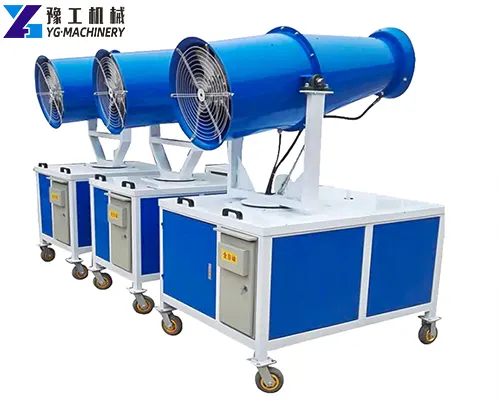
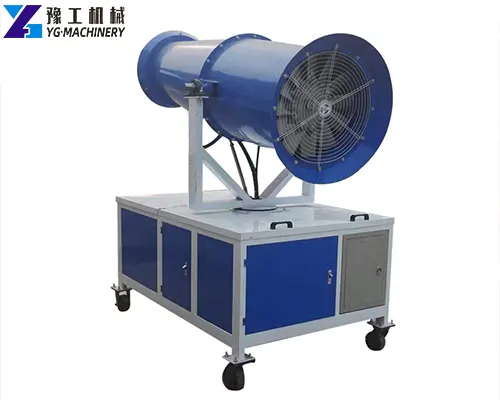
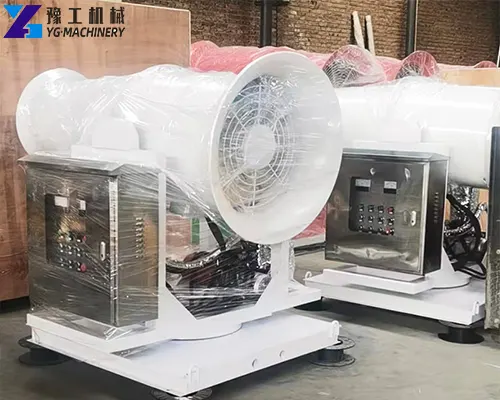
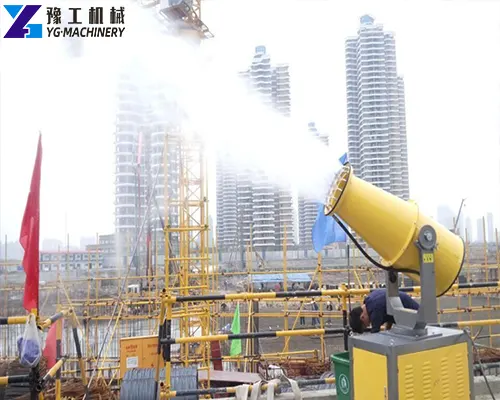
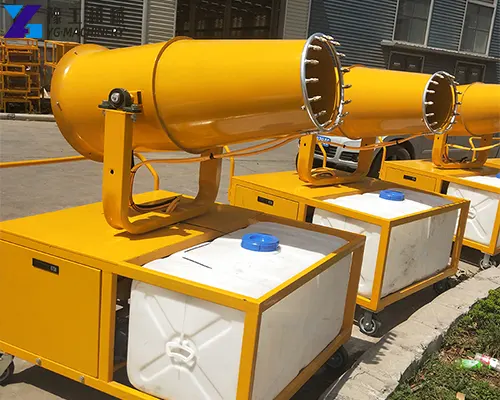
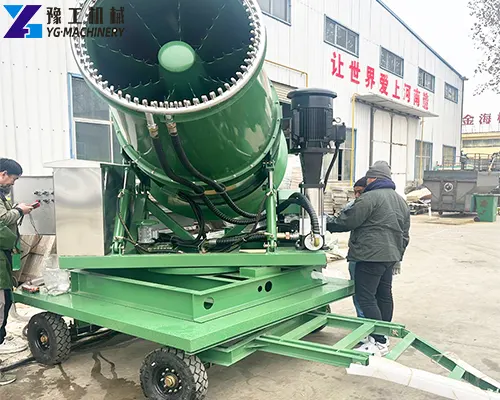
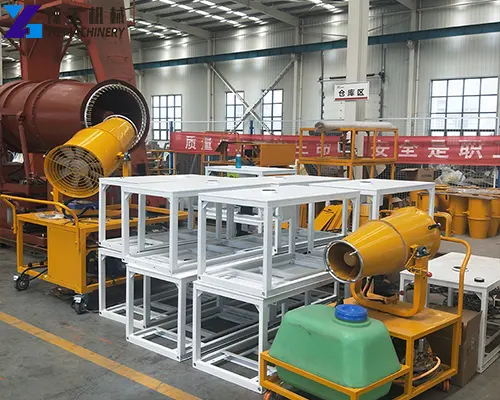
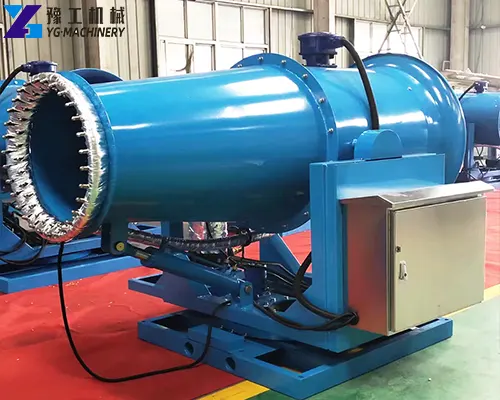
A fog cannon machine converts water into a fine mist and projects it toward airborne dust sources to suppress dust at construction, mining, quarry, demolition, port, and industrial sites. YG Machinery supplied a fog cannon solution to a customer in Chile. The solution can be configured with a trailer, water tank, and generator set according to project requirements. The final configuration depends on the site’s dust source, required spraying distance, water supply, power supply, and mobility requirements.
Send your project location, dust source, required spraying distance, and available power supply to YG Machinery for a suitable configuration.
Chile Sales Case: Fog Cannon Machine for Dust Suppression
YG Machinery supplied a fog cannon machine solution to a customer in Chile. The customer selected the main fog cannon according to the required spray distance and planned to use supporting equipment such as a trailer, water tank, and generator set according to the final site configuration.
The customer needed mobile dust suppression equipment that could move between different work zones rather than remaining fixed at one location. Manual water spraying with hoses or water trucks can be labor-intensive and may not reach elevated or wide-area dust sources effectively. A fog cannon machine can project a fine water mist over a longer distance, covering a larger working area from a single position.
The trailer allows the unit to be towed between work zones. The water tank supports operation where a fixed water pipeline is not available. The generator set provides independent electrical power where grid connection is impractical.
Why Do Chilean Contractors Use Fog Cannon Machines?
Dust is a persistent challenge across many Chilean industries. Construction sites generate dust from excavation, demolition, loading, unloading, and internal vehicle movement. Quarries and mining operations produce dust along haul roads, at crushing and screening stations, on stockpiles, and during material transfer. Road and bridge projects create dust along temporary access routes and earthwork areas. Ports handle bulk materials that release dust during storage, loading, and unloading.
Many of these sites share common problems:
Limited fixed water supply. Work zones may be far from water pipelines, especially in remote mining or road construction areas.
Multiple dust sources. Dust is generated at different locations within the same site, requiring equipment that can be repositioned.
Variable site conditions. Wind, terrain, and working-area size change from project to project.
Labor and equipment costs. Manual hose spraying requires dedicated workers and may not cover large or elevated areas efficiently.
A fog cannon machine is designed for wet dust control. It can help suppress airborne dust near the source and may improve dust-control efficiency compared with basic hose spraying in suitable conditions. Actual performance depends on wind, water supply, nozzle condition, dust concentration, and site layout.
Where Are Fog Cannon Machines Used in Chile?
Construction Sites
Excavation, demolition, material loading and unloading, and internal vehicle traffic all generate airborne dust. A mobile fog cannon can be positioned near the active work area and repositioned as the site evolves. The electric motor produces no direct exhaust emissions from the fog cannon itself, which is beneficial on enclosed or semi-enclosed urban sites.
Mining and Quarry Sites
Haul roads, crushing and screening stations, stockpiles, and material transfer points generate significant dust. A long-range model such as the YG-60 can cover larger dust sources from a distance. Trailer mounting allows the unit to follow active mining or quarrying faces as they advance.
Road and Bridge Projects
Temporary roads, earthwork zones, and construction access routes create dust along extended corridors. A trailer-mounted fog cannon can be towed to different sections of the project, suppressing dust near grading, excavation, and hauling operations.
Ports and Industrial Sites
Bulk material handling—including aggregates, cement, grain, and minerals—releases dust during storage, loading, and unloading. A fog cannon can be positioned near conveyor transfer points, storage yards, or truck loading areas. The fine mist helps settle airborne particles without saturating the material.
Demolition Projects
Demolition generates large volumes of dust in short periods. A fog cannon can be positioned upwind of the demolition zone, projecting mist into the dust cloud. The unit can be repositioned as debris is cleared and new sections are taken down.
How Do the Trailer, Water Tank, and Generator Set Work Together?
The fog cannon is the core dust suppression unit. The trailer, water tank, and generator set are supporting components that improve mobility and independent operation. Buyers can select any combination based on project conditions.
Trailer
The trailer mounts the fog cannon (and optionally the water tank and generator set) on a towable chassis. This allows the equipment to move between work zones without a crane or forklift. It is particularly useful for:
Road and bridge projects with multiple dust points along a corridor.
Demolition sites where the dust source shifts as work progresses.
Quarries with active faces, haul roads, and stockpile areas in different locations.
Construction sites with changing excavation and loading zones.
Trailer dimensions, axle design, towing method, load capacity, and road-legal requirements must be confirmed for the final configuration. These details are not invented in this article.
Water Tank
The water tank stores water for mobile operation. It is valuable where a fixed water pipeline is unavailable, such as remote mining areas, rural road projects, or large open sites. Important considerations:
Tank capacity must be matched with the fog cannon’s water consumption and expected operating time.
For example, a YG-40 consuming 3,000 L/h with a 480 L integrated tank would need water replenishment at intervals depending on usage.
A separate trailer-mounted tank may provide larger capacity than the integrated tank on selected models.
Do not assume that the stated YG-30, YG-40, or YG-60 integrated tank capacity automatically applies to a separate trailer tank.
Water quality should also be considered. Water with high sediment content may accelerate nozzle wear and require filtration.
Generator Set
The standard YG fog cannon uses an electric motor powered by 380 V / 50 Hz / 3-phase electricity. Where grid power is unavailable, a diesel or gasoline generator set can provide independent power. Key points:
Generator capacity must be selected according to the fog cannon’s fan motor (3 kW), steering motors (two × 1.5 kW), pump load, starting current, and any other connected equipment.
The generator power rating is not stated in the supplied data and must be confirmed by YG engineers.
An undersized generator may cause voltage drops, motor overheating, or startup failures.
Generator fuel consumption, runtime, and noise level should be discussed with YG based on the selected model.
Available Configuration Options
Buyers may purchase:
Fog cannon only — for sites with existing power and water supply.
Fog cannon + trailer — for mobility where power and water are available at each work zone.
Fog cannon + water tank — for sites with power but limited water access.
Fog cannon + generator set — for sites with water access but no grid power.
Complete trailer-mounted system — fog cannon, water tank, and generator set on one towable chassis for fully independent mobile dust suppression.
The final combination depends on the buyer’s project conditions and quotation.
How Do You Select the Right Fog Cannon for Your Project?
Use this checklist before requesting a quotation:
Required spraying distance (20 m, 30 m, 40 m, or 60 m)
Dust source type (excavation, crushing, demolition, haul road, stockpile, material transfer)
Dust concentration level
Working-area size and layout
Wind speed and prevailing direction
Water source location and water quality
Expected daily operating hours
Available electricity (grid power or no grid power)
Need for a generator set
Need for a trailer
Required water tank capacity
Site access and towing conditions
Ambient temperature and altitude
Maintenance and spare-parts requirements
Project location in Chile
Delivery port or final delivery address
Key selection principles:
Longer range is not always better. A YG-60 may produce more mist than needed for a compact site, wasting water and power. Match the range to the actual dust source distance.
Wind matters. Crosswinds can carry mist off target. Position the unit upwind and consider whether a shorter-range model in a better position may outperform a long-range model in poor wind conditions.
Water consumption must be planned. A YG-60 consuming 7,500 L/h requires a substantial water supply or frequent refilling. Size the water tank accordingly.
Generator capacity must be confirmed. Do not assume a generic generator will handle the motor load and starting current. YG engineers should specify the required generator rating.
Site access affects the trailer choice. Confirm that towing routes can accommodate the trailer dimensions and weight.
Send your completed checklist to YG Machinery to receive a model recommendation and quotation.
Frequently Asked Questions About YG Fog Cannon Machine
Q1: What is a fog cannon machine?
A1: A fog cannon machine is a wet dust suppression device that uses a high-powered fan and nozzle system to project a fine water mist over a working area. The mist droplets contact airborne dust particles, causing them to settle. It is commonly used at construction, mining, quarry, demolition, port, and industrial sites.
Q2: How does a fog cannon suppress dust?
A2: The machine atomizes water into fine droplets (approximately 50–150 microns for YG models) and projects them through a fan toward the dust source. When the droplets collide with airborne dust particles, the particles gain weight and settle to the ground. This is a wet suppression method; it does not remove or filter every dust particle from the air.
Q3: Can the fog cannon be supplied with a trailer?
A3: Yes. A trailer arrangement can be discussed as part of the final configuration. The trailer allows the fog cannon to be towed between work zones. Trailer dimensions, axle design, load capacity, and towing requirements must be confirmed for the selected model.
Q4: Does the system require a generator?
A4: The YG fog cannon uses an electric motor requiring 380 V / 50 Hz / 3-phase power. If grid electricity is available at the site, a generator is not required. If the site has no grid power, a generator set can be supplied. The generator capacity must be confirmed by YG engineers based on the motor load and starting current.
Q5: Which fog cannon model is suitable for my project?
A5: The model depends on your dust source, required spraying distance, working-area size, water supply, power supply, wind conditions, and mobility requirements. Provide YG with your project location, dust source type, spraying distance, water and power availability, and whether you need a trailer or generator. YG engineers will recommend the appropriate model.
Q6: How can I request a quotation?
A6: Send YG Machinery the following information: project location, dust source type, required spraying distance, water supply situation, available power supply, whether a trailer or water tank is needed, preferred delivery port, and expected purchase date. YG will recommend a configuration and provide a quotation.