
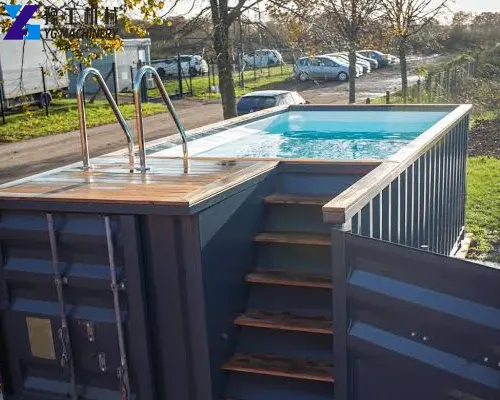
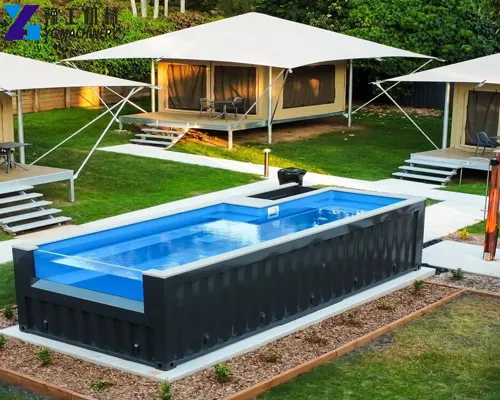
When people think of “home swimming pools,” many immediately picture a spacious backyard, a lush lawn, and a traditional in-ground pool. However, not everyone has a large yard, and not every family is willing to undertake major construction for a pool. Therefore, a more flexible and modern option has gained attention—the shipping container swimming pool.
It liberates the “pool” from fixed settings, no longer requiring a large open space, and is no longer limited by traditional construction methods. Whether you have a small yard, a narrow, long open space, a sloping plot, or want to integrate the pool into a terrace, platform, or even a rooftop landscape, as long as the space is suitable, a container pool can be a viable solution.
More importantly, a container pool is not simply “putting water in a box.” It involves a systematic solution encompassing prefabrication, modification, transportation, and on-site installation. Because of its more flexible installation method, it has the opportunity to enter more homes and even become a highlight of yard design.
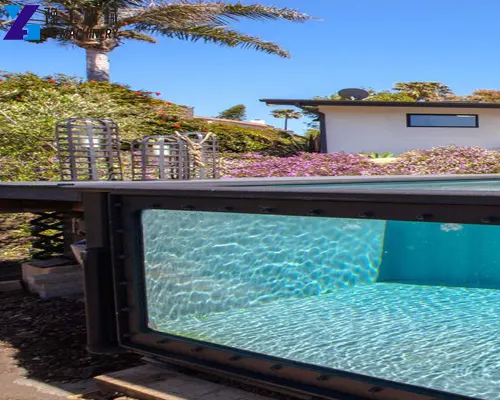
What is a Shipping Container Swimming Pool?
A container swimming pool is a prefabricated swimming pool made from a shipping container. Common sizes are typically 20-foot or 40-foot containers. After cutting, reinforcement, waterproofing, lining, and equipment integration, it becomes a ready-to-use swimming pool system. Compared to traditional concrete pools, the biggest difference with container pools is their higher degree of factory prefabrication. This means that many key steps, such as pool construction, piping layout, insulation, and installation of some equipment, can be completed before leaving the factory. On-site, only foundation construction, hoisting, connection, and commissioning are required.
This brings several significant advantages. First, a shorter construction period. Second, more flexible installation methods. Third, greater adaptability to site conditions. For those who don’t have a large yard but still want a private pool, this product is almost made for those with limited space.
Why Are Container Swimming Pools Suitable for Families Without a Large Yard?
Many people think that swimming pools must occupy a large area of land, but this is not the case. What truly determines whether a pool can be installed is not just the area, but also the spatial shape, load-bearing capacity, equipment accessibility, and construction accessibility.
The advantage of container pools lies in their adaptability to different site conditions. You don’t necessarily need a large, standard backyard; you can utilize existing open space, side yards, slopes, platforms, or even partially embed them into the terrain. In other words, it’s more like “customizable outdoor furniture” than a large-scale project that requires complete demolition.
This flexibility is especially important for urban residences, townhouses, small villas, or vacation rentals. The challenge for many projects isn’t “whether you want a pool,” but rather “whether you can even put one in.” Container pools offer a relatively practical answer to this question.
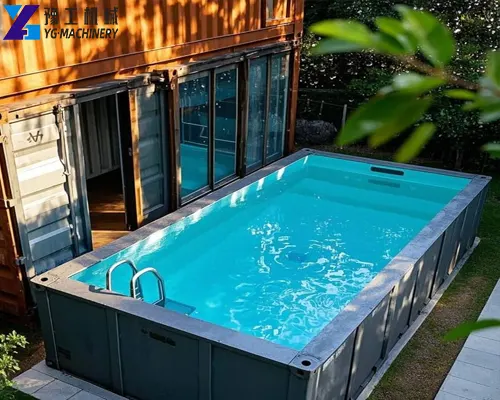
5 Ways to Install a Container Swimming Pool—Option 1: Above-Ground Installation – Fastest, Cheapest, Most Flexible
Suitable for: People with a small, flat plot of land, a limited budget, who want to use the pool as quickly as possible, and who may move or relocate it in the future.
- Installation Difficulty: ★☆☆☆☆
- Cost Index: ★★☆☆☆
- Construction Time: 1-2 days (if the site is ready)
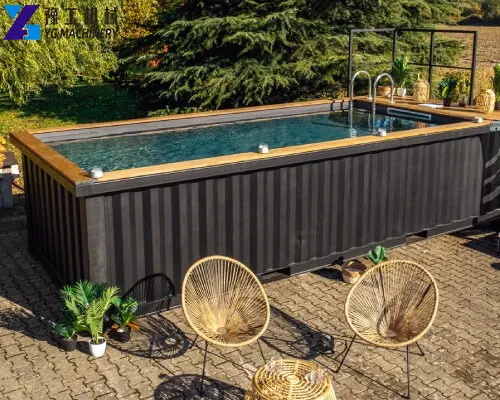
The above-ground installation is the most basic method – create a flat, solid base on the ground, place the container pool directly on it, connect water and electricity, and you’re done.
How to Create the Base? Two Main Methods:
- Concrete Base: Create a 10- 15 cm thick concrete floor, 30- 50 cm larger than the bottom of the shipping container swimming pool. Advantages: Sturdy, flat, and with even weight distribution, suitable for long-term fixed placement. Disadvantages: Higher cost, and once completed, it cannot be moved.
- Crushed stone compacted foundation: First, remove 15- 20 cm of topsoil, then backfill with crushed stone (or graded sand and gravel) in layers and compact it. Finally, lay a layer of permeable bricks or a leveling layer. The advantages are low cost and good drainage; the disadvantage is that the flatness is slightly inferior to concrete, requiring regular settlement checks.
Tip: Regardless of the foundation type, levelness is crucial. In a 20-foot pool that is nearly 6 meters long, even a 2cm difference between the two ends will result in a noticeable discrepancy in visual appearance and water level. The professional practice is to use a laser level to mark the lines, controlling the error within ±3mm.
Advantages:
- Fastest speed; once the site is prepared, simply place a crane, connect water and electricity, and it’s ready to use.
- No digging required, no earthwork, saving a significant amount of money.
- Simple approval process; in many areas, above-ground swimming pools require little to no permit.
- Movable; if you want to change location or move, just use a crane.
- Low soil requirements; suitable for sandy or sloping (after leveling) areas.
Disadvantages:
- Visually, it looks like “a metal box on the ground,” with a strong industrial feel; it requires a deck or exterior decoration to look good.
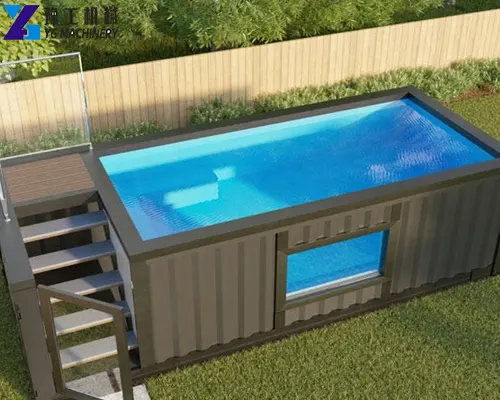
- Entering and exiting the pool requires climbing ladders or steps, which is not very user-friendly for the elderly or children.
- The steel walls are directly exposed to the air, making the water temperature highly susceptible to ambient temperature; it easily overheats in summer and dissipates heat quickly in winter.
- Relatively high (approximately 2.4 meters), requiring safety fencing or protection around the pool.
Real Case: A young couple in Brisbane, Australia, had a backyard of only about 40 square meters and wanted a place to swim in the summer despite a tight budget. They opted for a 20-foot container pool with a gravel foundation, which cost less than AU$2,000 and was installed by crane on the same day. The entire project, from order placement to filling with water, took only 10 days. Later, they spent approximately AU$2,000 on a wooden deck and steps on one side of the pool, instantly elevating its aesthetic appeal.
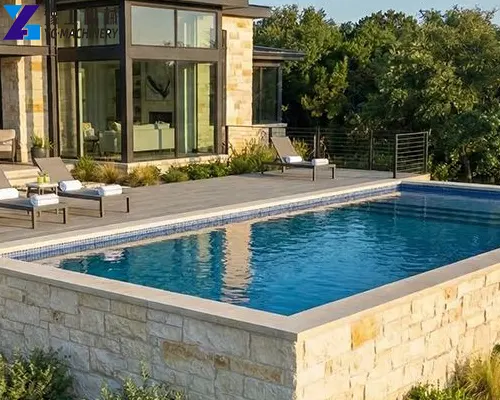
5 Ways to Install a Container Swimming Pool—Option Two: Semi-Round – The Perfect Balance Between Aesthetics and Practicality
Suitable for: Those who want to partially bury their container pool but have a limited budget, those whose terrain is too sloping to fully bury it, and those who want a “normal-looking pool” without major construction work.
- Installation Difficulty: ★★★☆☆
- Cost Index: ★★★☆☆
- Construction Period: 5-7 days
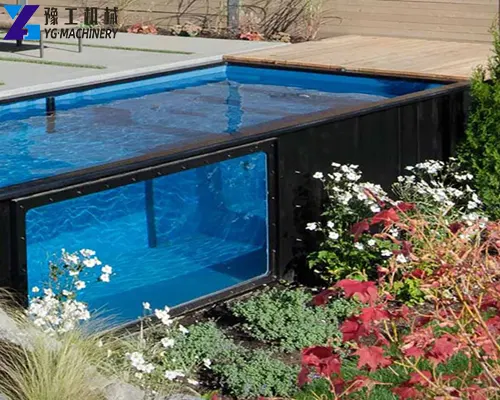
A semi-round, as the name suggests, involves burying a portion of the container pool in the ground, typically at a depth of 0.5-1.2 meters. This is a “middle option” that many people haven’t considered, but the actual experience is excellent.
Why Is It Considered the Perfect Balance?
- Easy Access: Half buried, half exposed, the height of a person standing on the ground is roughly the same as the pool water level; one step is all it takes to enter, no ladder needed.
- More Natural Appearance: Unlike a fully above-ground pool that looks like a “big metal box,” or a fully buried pool where the tank is completely invisible, the partially exposed metal walls paired with wooden decking create a stylish blend of industrial and natural aesthetics, perfect for photos.
- Better Insulation: The buried portion maintains a naturally constant temperature, resulting in less water temperature fluctuation and lower operating costs. Moderate Engineering Difficulty: Less deep excavation is required, reducing earthwork by half compared to a fully buried pool, thus lowering costs.
Key Technical Aspects of Semi-Buried Pools: Lateral Pressure Management
Many people think semi-buried pools are simpler than fully buried ones, but this is not the case. A fully buried pool has even soil support around its perimeter, while the exposed portion of a semi-buried pool lacks external support, and the underwater portion experiences lateral pressure from the soil, making the stress state more complex. Proper support structures for the backfilled sides are essential—usually this involves casting a reinforced concrete ring beam around the outside of the pool wall or reinforcing it with steel sections to prevent deformation.
Furthermore, drainage is also crucial for semi-buried pools. A drainage layer (gravel + infiltration pipes) must be installed around the buried portion to prevent the pool from floating due to rising groundwater levels during the rainy season. Yes, empty container pools can indeed float in areas with high water tables; this isn’t a joke, it’s a real engineering accident.
Advantages:
- Aesthetically pleasing, offering a sense of immersion while retaining an industrial style.
- Easy to enter and exit, providing a user experience similar to a traditional pool.
- Better insulation than fully above-ground pools, energy-efficient.
- Earthwork volume and cost are between fully above-ground and fully buried pools.
- Suitable for sloping terrain, utilizing the terrain and saving earthwork.
Disadvantages:
- Structural complexity is higher than fully above-ground pools, requiring a professional construction team.
- Partial excavation is still required, involving underground pipeline inspection.
- Drainage and anti-floating measures must be implemented thoroughly and cannot be omitted.
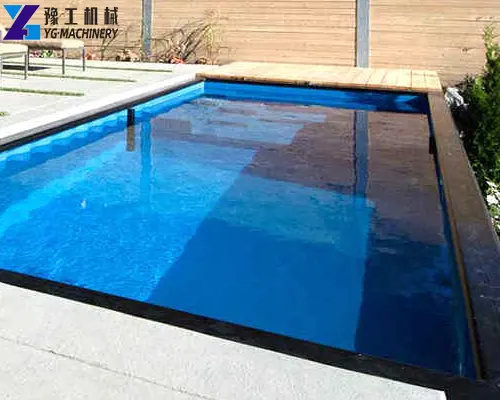
5 Ways to Install a Container Swimming Pool—Option 3: In-ground – Completely “Invisible,” Just Like a Traditional Pool
Suitable for: Those with ample yard space, seeking the visual effect of a traditional pool, with a sufficient budget, and planning for long-term, fixed use.
- Installation Difficulty: ★★★★★
- Cost Index: ★★★★★
- Construction Period: 2-4 weeks
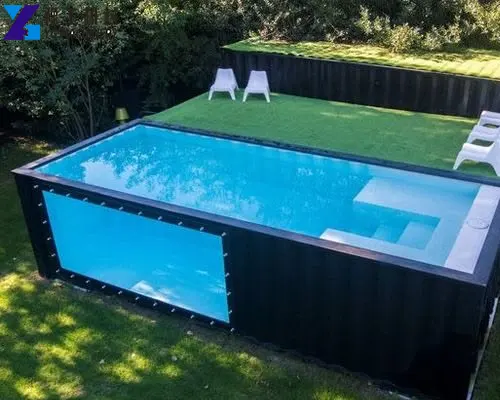
In-ground (fully buried) pools involve burying the entire shipping container swimming pool underground, with the pool opening flush with the ground. From above, it looks no different from a traditional pool. This offers the best visual effect and the most natural experience, but it is also the most complex to construct and the most expensive.
Key Challenges in In-ground Construction:
- Excavation and support. A pit 60- 100 cm larger on each side than the pool’s dimensions needs to be dug, with a depth equal to the pool’s height plus the thickness of the foundation. In areas with poor soil quality, foundation support is required to prevent collapse.
- Foundation. A reinforced concrete slab foundation, at least 20cm thick, is constructed at the bottom, reinforced with double-layer steel mesh. 1. The foundation must be absolutely level; otherwise, uneven stress on the pool after placement will lead to deformation or even leakage over time.
- Lateral pressure and backfill. This is the most critical technical aspect of a fully buried container pool. The container’s sidewalls are designed to “bulge outwards when filled with water,” but once buried, the external soil pressure is directed inwards, reversing the direction of stress. Without proper treatment, the container’s sidewalls may collapse under the pressure of the soil. The professional approach is to pour a reinforced concrete retaining wall between the pool’s outer wall and the soil, or to reinforce the pool walls with steel sections, transferring the lateral soil pressure to the foundation. Backfill material must be graded sand and gravel, compacted in layers; using virgin soil directly can cause uneven settlement.
- Anti-buoyancy design. As mentioned earlier, empty container pools can float in areas with high water tables. Solutions include: adding concrete counterweights to the bottom, anchoring the pool walls and foundation, and installing a drainage system to lower the water table.
- Pool opening treatment. The area around the pool opening needs coping, which can be done using materials such as stone, ceramic tiles, or treated wood. This is both aesthetically pleasing and prevents surface water backflow.
Advantages:
- Most similar in appearance to a traditional swimming pool, seamlessly integrating into the landscape.
- Best user experience, easy access, and the surrounding area can be used for a courtyard or terrace.
- Best insulation, resulting in the most stable water temperature.
- Does not occupy above-ground space, keeping the yard looking intact. Good property value retention, positively impacting property appreciation.
Disadvantages:
- Most expensive; construction costs can be 2-3 times that of a fully above-ground pool.
- Longest construction period, involving multiple processes such as earthwork, concrete, and curing.
- Most complicated approval process, almost always requiring a building permit.
- Once buried, it cannot be moved, completely losing its mobility.
- Relatively troublesome maintenance, requiring equipment inspection and repair in the pit.
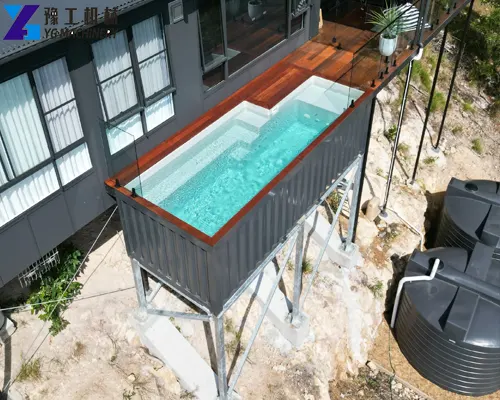
5 Ways to Install a Container Swimming Pool—Option 4: Rooftop/Terrace Type – A Private Oasis in the City
Suitable for: Urban apartment/penthouse residents with a load-bearing roof or large terrace, seeking unparalleled views and privacy.
- Installation Difficulty: ★★★★☆
- Cost Index: ★★★★☆
- Construction Period: 1-2 weeks (structural assessment required)
“I live in a high-rise, can I install a swimming pool?” This is one of the most frequently asked questions by urban clients. The answer is: Yes, but only if the structure has sufficient load-bearing capacity.
This is not a simple matter. A 20-foot container swimming pool filled with water weighs approximately 28-30 tons (including its own weight), equivalent to placing more than 20 small cars on the roof. Not all rooftops can withstand this.
3 Things That Must Be Done Before Rooftop Installation:
- First: Structural load-bearing calculation. Have a qualified structural engineer conduct an on-site survey to calculate the actual load-bearing capacity of the roof (dead load + live load). Generally, the design live load for residential building rooftops is approximately 2.0-2.5 kN/m² (about 200-250 kg/m²), while swimming pool loads start at 1 ton/m², far exceeding this. It’s necessary to locate the beams, columns, and other load-bearing components and transfer the pool’s load to the main structure via steel structural blocks or distribution beams.
- Secondly: Confirm the hoisting plan. Hoisting the container pool to the rooftop requires a crane. It’s necessary to confirm: Is the crane allowed into the residential area/street? Is the boom length sufficient? Are there any high-voltage lines, trees, or other buildings obstructing the view? These factors directly impact feasibility and cost.
- Thirdly: Waterproofing and drainage. The biggest concern with rooftop swimming pools is leakage. Once it leaks, the ceilings and renovations of the downstairs residents will be damaged, and the compensation claims could far exceed the pool’s cost. Therefore, rooftop installations require double or even triple waterproofing: waterproofing of the pool itself + a comprehensive waterproofing layer on the rooftop platform + a water collection tray/drainage channel beneath the pool. In case of leakage, it can be drained away through the drainage system, preventing seepage into the floor slab.
Unique Advantages of Rooftop Installation:
- Unbeatable views, offering unobstructed city skyline vistas.
- Good privacy, unseen by neighbors.
- Does not occupy ground space, making it the only option for urban residents without yards.
- Ample sunlight, resulting in rapid water temperature rise in spring and autumn.
Issues to Consider:
- Strong winds, especially on high floors, requiring windbreaks or glass railings.
- Colder winters, increasing insulation and heating costs. Difficult access for maintenance equipment; choose low-failure-rate configurations.
- Some communities/cities have explicit regulations prohibiting rooftop swimming pools; check policies beforehand.
Real-life example: A penthouse owner in downtown Bangkok, Thailand, wanted to install a swimming pool on their 30-square-meter terrace. After an on-site assessment by a structural engineer, a steel structure distribution beam scheme was designed to transfer the pool load to the column grid below, along with a triple waterproofing + water collection tray system. A 120-ton truck crane lifted a 20-foot swimming pool from one side of the street to the 18th floor. The entire installation process took three days, with only half a day actually spent on the lifting itself; most of the time was spent on structural reinforcement and waterproofing.
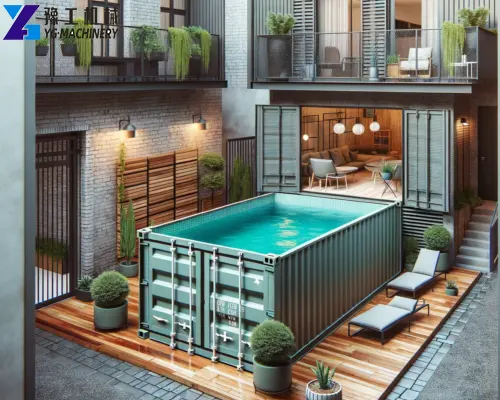
5 Ways to Install a Container Swimming Pool—Option 5: Indoor/Narrow Space Installation – Can be installed in basements, garages, and balconies
Suitable for: Those who want year-round heated swimming, unaffected by weather, or those with no outdoor space and must install indoors.
- Installation Difficulty: ★★★☆☆
- Cost Index: ★★★☆☆
- Construction Period: 1-2 weeks
Many people don’t know that container swimming pools can also be installed indoors – in basements, garages, sunrooms, and unused large living rooms, as long as there is enough space, ceiling height, and floor load-bearing capacity.
Several Prerequisites for Indoor Installation:
- Is there enough space? The dimensions of a standard 20-foot container swimming pool are approximately 6.06m × 2.44m × 2.59m (length × width × height). At least 60cm of access space must be left around the pool (more than 1 meter is needed at the equipment end). In other words, the room’s net dimensions must be at least 7m × 4m × 2.8m to fit comfortably. If space is extremely limited, a 10-foot (approximately 3-meter long) mini shipping container swimming pool is also an option, suitable for balconies or small patios.
- Is the load-bearing capacity sufficient? Like rooftop installations, the ground’s load-bearing capacity is a crucial factor. Basement floors typically rest directly on the foundation, so load-bearing capacity is generally not an issue. However, if it’s an upstairs room (such as a large room on the second floor converted into a pool), structural calculations must be performed, with the same stringent requirements as rooftop installations.
- How to solve ventilation and dehumidification? This is the most easily overlooked but crucial issue for indoor pools. With continuous evaporation of pool water, poor ventilation will result in a perpetually damp room, leading to moldy walls, rusted metal, warped floors, and even health problems for occupants. The professional approach is to install a pool-specific dehumidifier or a constant temperature and humidity system. Additionally, the walls and ceilings must be made of waterproof and moisture-proof materials, and the floor must have a slope and a drain.
Advantages of Indoor Installation:
- Year-round usability, unaffected by weather, even in winter.
- Best privacy, completely at home.
- With a constant temperature system, water temperature and quality are more stable.
- No need to worry about wind and sun, resulting in a longer lifespan for the pool itself.
Disadvantages of Indoor Installation:
- Limited space; cannot accommodate large pools.
- Dehumidification and ventilation systems are an additional investment and consume electricity.
- Can create a feeling of oppression if ceiling height is insufficient.
- Moving in and out is an issue—if the renovation is already complete, the doors and windows may not be large enough, and the container may not fit (this must be confirmed in advance!).
Creative Variation: “Dual-Purpose Container” Some customers place the container pool in their garage, swimming regularly and draining (or leaving some) of the water when parking—while impractical for daily use, it’s perfectly feasible for seasonal use (e.g., only in summer).
How to Choose from 5 Ways to Install a Container Swimming Pool? A Table Helps You Make a Quick Decision
| Comparison Dimensions: | Floor-standing | Semi-recessed | Fully embedded | Rooftop/Terrace Style | Indoor |
| Cost | Low | Medium | High | Medium-High | Medium |
| Construction Period | 1-2 days | 5-7 days | 2-4 weeks | 1-2 Weeks | 1-2 weeks |
| Approval Difficulty | Low | Medium | High | High | Medium |
| User Experience | Average | Good | Best | Excellent | Very good |
| Visual Effect | Industrial style | Eclectic style | Most natural | Best View | Privacy |
| Portability | Best | Poor | Cannot be moved | Difficult to Move | Difficult to move |
| Insulation and Energy Saving | Poorest | Medium | Best | Poor | Good (with thermostat) |
| Site Requirements | Lowest | Medium | Highest | Highest Load-Bearing Capacity | Medium-high (load-bearing + space) |
| Suitable Audience | Limited budget/Want to own quickly | Seeking a balanced experience | Pursue the best effect | High-End Urban Residence | Year-round use/No outdoor space |
Purchase Container Swimming Pools from Yugong Machinery — Factory Price
The popularity of container swimming pools isn’t because they’re the “cheapest pools,” but because they’re the most flexible. Traditional pools can only be built in a pit, while container pools can be placed on the ground, partially or fully buried, on rooftops, or even indoors—as long as the load-bearing capacity and space meet the requirements, they can appear almost anywhere you can imagine.
However, flexibility doesn’t mean carelessness. Regardless of the installation method chosen, structural safety, waterproofing quality, and a level foundation are three things that cannot be compromised. A cheap solution isn’t necessarily cheaper, and an expensive solution isn’t necessarily suitable for you. The key is to choose the most suitable option based on your space, budget, and usage habits.
If you’re also considering getting a shipping container swimming pool but unsure which installation method suits your site, feel free to send us your site details (size, floor level, budget range, local climate), and YG engineers can provide a free evaluation.
Contact YG Machinery:
- WhatsApp/WeChat: +86 136 1385 6800
- Email: admin@yugongmachinery.com
We support worldwide shipping and provide technical support and installation guidance in both Chinese and English.
