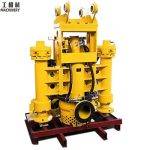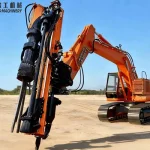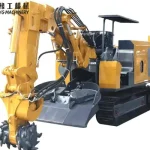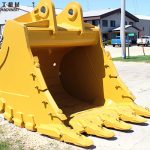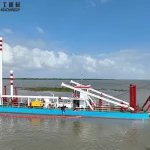
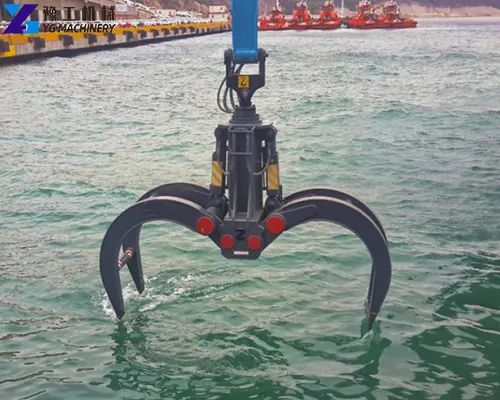
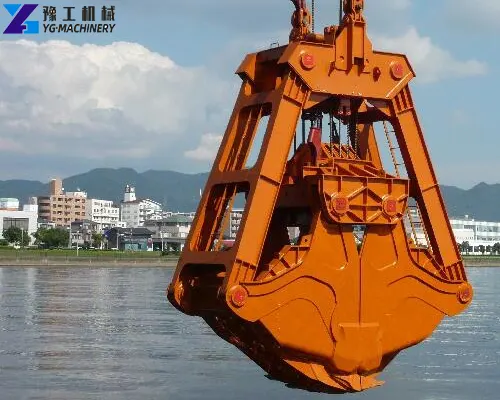
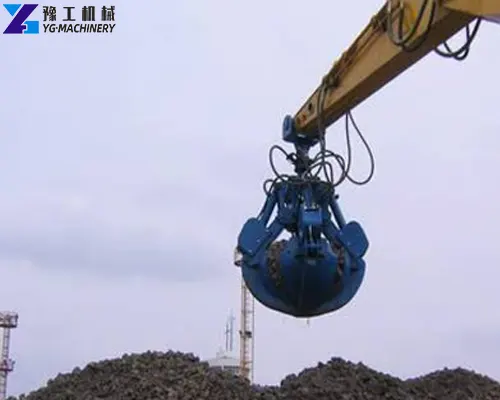
Have you ever encountered these situations: halfway through excavating a foundation pit, a regular excavator bucket can’t reach the deep excavated soil; during river dredging, mud and water leak out through the gaps in the bucket teeth; when unloading grain at a port, even three buckets aren’t enough to fill a truckload of bulk material? The root cause of these problems isn’t that your excavator is inadequate, but that you’re using the wrong attachments. An excavator dredge grab (also known in the industry as a clamshell grab, shell grab, or double-lobed grab) is a vertical loading and unloading attachment that uses hydraulic cylinders to drive two symmetrical bucket lobes to open and close, “biting” the material like a clamshell. It doesn’t rely on horizontal digging, but rather cuts vertically in from above, closes, and lifts, making it particularly suitable for scenarios where ordinary excavator buckets are ineffective, such as deep foundation pits, underwater dredging, and bulk material loading and unloading at ports.
YG’s YGCS series of dredging grab buckets covers excavators ranging from 7 to 35 tons and has been exported to more than 60 countries and regions in Southeast Asia, the Middle East, Africa, Latin America, and Europe, serving a wide range of industries including ports, municipal works, mining, demolition, and grain storage. If you have any needs, please contact us now for more product information and pricing.
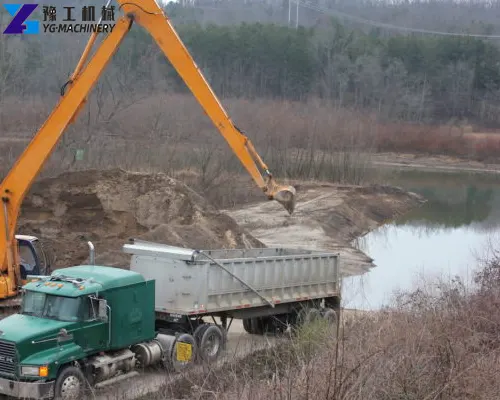
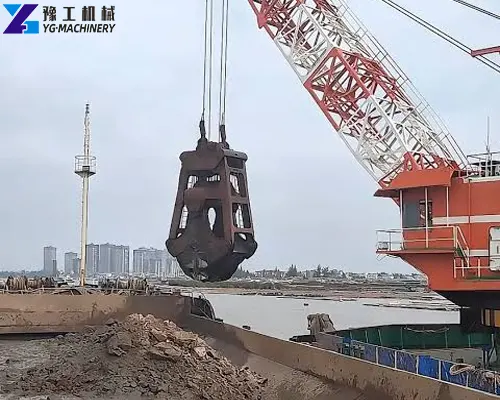
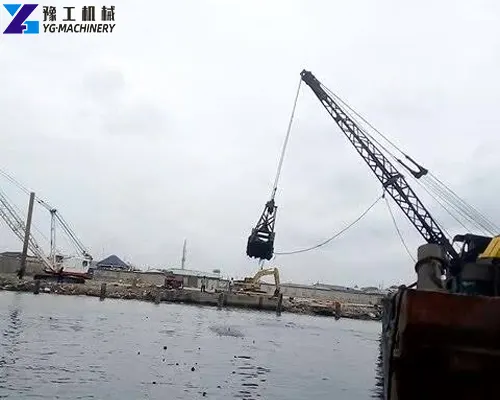
Find Your Dredging Application – River, Harbor, Canal, Pond
Check the YG Hot-Sale Excavator Dredging Grab Technical Parameters
| Parameters/Model | YGCS04 | YGCS06 | YGCS08 | YGCS10 |
| Compatible Excavator Tonnage | 7–11 tons | 12–18 tons | 18–25 tons | 26–35 tons |
| Weight | 800 kg | 1200 kg | 2000 kg | 2300 kg |
| Maximum Opening Size | 1000 mm | 1500 mm | 2200 mm | 2300 mm |
| Working Pressure | 180 bar | 210 bar | 250 bar | 250 bar |
| Set Pressure | 250 bar | 290 bar | 320 bar | 340 bar |
| Working Flow Rate | 190 L/min | 210 L/min | 220 L/min | 240 L/min |
| Applicable Working Conditions | Municipal, agricultural, narrow alleyway | Pit, port bulk materials | Heavy load, ports, mines | Deep water dredging, large ore blocks |
Check Working Pressure & Flow Requirements – View Specs
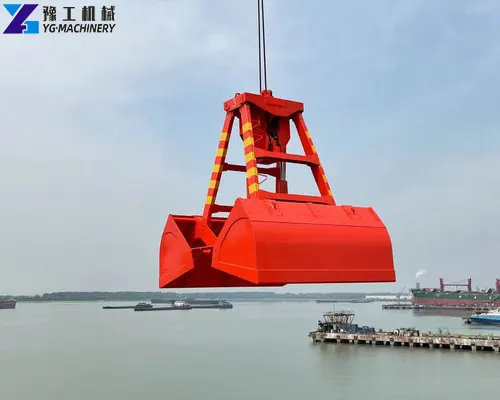
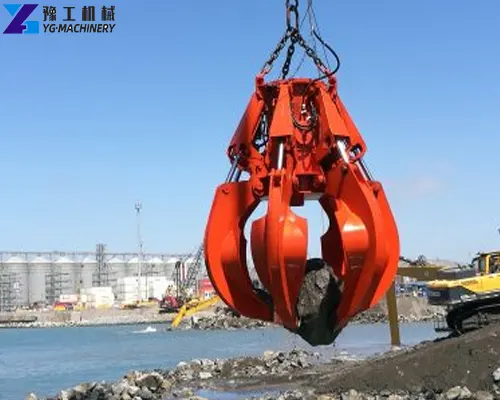
Core Structure Components of an Excavator Dredging Grab Bucket
- Shells: Two symmetrical, arc-shaped steel shells that form a sealed compartment when closed. Welded from NM400/NM500 wear-resistant steel plates, with reinforced and thickened key stress points.
- Hydraulic Cylinders: Typically equipped with 1-2 large-diameter cylinders to provide closing force. Cylinder rods are hard chrome plated for corrosion and scratch resistance.
- Hinge & Equalizer Bars: Convert the linear thrust of the cylinders into the arc-shaped opening and closing motion of the bucket segments.
- Pins & Bushings: Large-diameter alloy pins with oil-fillable bushings to reduce play.
- Rotator (Optional): Enables 360° rotation for easy alignment in confined spaces.
- Hydraulic lines and quick-connect couplings: Connect to the excavator’s auxiliary lines (auxiliary hydraulic lines).
- Drainage Vents: Allow water to drain and retain solid materials during underwater operations.
Standard excavator buckets are suitable for continuous “horizontal push-shove + boom raising” operations, while excavator dredge grabs follow a cyclical route of “vertical descent – closing – lifting – rotation – unloading.” The two attachments are not substitutes but complement each other.
Which Industries and Scenarios Truly Require Excavator Clamshell Grab Buckets for Dredging?
- River, lake, and reservoir dredging: Retrieving silt, mud, and aquatic plants underwater, while retaining solids through drainage holes.
- Port bulk cargo handling: Unloading and transferring coal, ore, grain, fertilizer, and wood chips.
- Excavator clamshell grab for bulk material: Standard equipment in ports.
- Deep foundation pit and caisson construction: Vertical excavation for subway construction, bridge piers, underground utility tunnels, and deep wells.
- Municipal pipeline and trench excavation: Vertical excavation of pipeline trenches under narrow urban roads without damaging surrounding surfaces.
- Mining and quarrying: Retrieving crushed ore after blasting, cleaning tailings, and loading slag onto trucks.
- Grain storage and feed mills: Transferring bulk grain to storage, loading onto trucks, and unloading from ships; leak-proof design ensures no material spillage.
- Building demolition and waste sorting: Grabs concrete blocks, steel bars, and waste wood; when used with a lotus-shaped grabber, it can sort more complex waste materials.
- Environmental protection and solid waste treatment: Removes contaminated sediment, treats steel slag, and feeds waste into incineration plants.
In-Stock Dredging Grabs Ready to Ship – See What’s Available
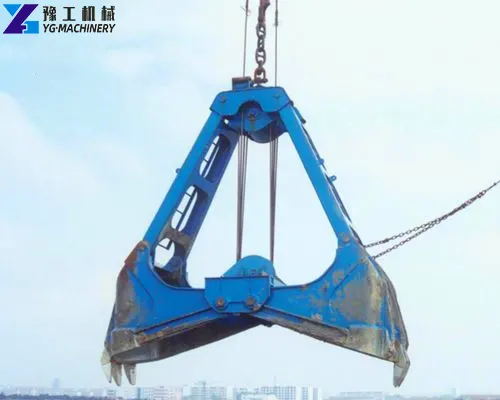
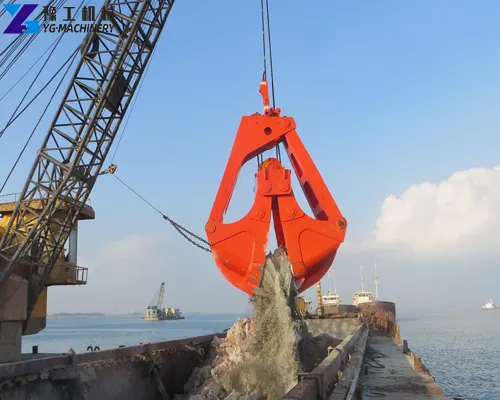
Case Studies and Reviews of YG Excavator Dredging Grabs Used by Customers in Saudi Arabia and Vietnam
Case Study 1: Bulk Grain Loading and Unloading at Ho Chi Minh Port, Vietnam – Leak-Proof Grab Bucket Solves Spillage Problem
Client Background: A grain trader in Ho Chi Minh City handles 300,000 tons of corn and dried cassava annually. Their existing excavator buckets caused severe spillage during loading and unloading, requiring three workers daily at the dock for cleanup.
Solution: Equipped their two 20-ton Hyundai excavators with YGCS08 excavator dredge grab buckets for grain, enhancing the seal at the two-part joint and adding rubber sealing strips to the bucket opening.
Usage Results:
- Single bucket loading capacity increased from 0.8 m³ to 1.4 m³;
- Bulk grain spillage rate decreased from approximately 3% to below 0.5%;
- Dock cleaning staff reduced from 3 to 1;
Customer Feedback: “We used to lose grain every shift. Now the dock stays clean, and we load faster.”
Case Study 2: Riyadh, Saudi Arabia Deep Foundation Pit Project – High Temperature Resistance and Vertical Excavation
Customer Background: A construction contractor in Riyadh undertook a 14-meter-deep underground parking pit project. Summer ambient temperatures exceeded 45℃, causing frequent overheating of the hydraulic system in ordinary attachments.
Solution: YGCS08 attachments with extended booms were selected, a radiator was added to the hydraulic system, and high-temperature-resistant fluororubber components were used for cylinder seals.
Performance Results:
- Oil temperature remained stable below 80℃ for 6 consecutive hours of operation;
- Vertical excavation replaced the original “long-arm excavator + manual bottom clearing” method, reducing manual labor at the bottom of the foundation pit by 60%;
- The project was completed 18 days ahead of schedule.
Customer Review: “The clamshell goes straight down and comes back full. We don’t reposition the machine every ten minutes anymore.”
Customize Your Dredging Grab for Free – Start Now
How to Choose the Right Excavator Grab Bucket for Your Project?
Choosing a grab bucket isn’t about getting the biggest one; the key is matching it to your excavator, the material, and the working conditions.
1. Excavator Tonnage and Hydraulic Flow Rate
First, check the flow rate and pressure of your excavator’s auxiliary hydraulic circuit. Insufficient flow rate results in slow closure; excessive flow rate damages the seal. YGCS04 requires 190 L/min, and YGCS10 requires 240 L/min. Make sure the after-sales service can check this for you before purchasing.
2. Material Density Determines Bucket Capacity
- Heavy materials (wet sand, iron ore, compacted clay): Choose a narrow bucket, reinforced type, and toothed design to avoid overloading.
- Light materials (grain, coal, wood chips): Choose a wide bucket, large-capacity lightweight bucket to maximize the single-bucket tonnage.
3. Working Environment Determines Whether to Choose a Corrosion-Resistant/Underwater Type
For long-term underwater operations, choose a grab bucket with a marine-grade anti-corrosion coating, dedicated sealing cylinders, and drainage holes. In seawater environments, sacrificial anode blocks are also required to prevent electrochemical corrosion.
4. Space Limits Determine the Need for Rotation
When space is limited and frequent relocation is not possible, 360° rotation is essential; if the unloading direction is fixed, fixed suspension is more cost-effective.
5. Pay Close Attention to Pins and Bushings
Large-diameter pins and oil-lubricated bushings can significantly reduce play and abnormal noise after 2-3 years of use. Don’t skimp on this small component.
Lock In Today‘s Factory Price – Request Quote Now
6 Frequently Asked Questions about Excavator Attachments and Dredging Grab Buckets
Q1. Is the excavator dredge grab suitable for my excavator?
A1: The YGCS series covers mainstream excavators ranging from 7 to 35 tons. Just tell us your excavator brand, model, auxiliary hydraulic flow rate, and pressure, and we can match the appropriate model.
Q2. Can the Anti-leak dredge grab truly prevent food leakage?
A2: The leak-proof design is achieved through precision-machined mating surfaces, rubber sealing strips, and a small closing gap. The leakage rate for fine materials such as dry sand, corn, and wheat can be controlled below 0.5%. However, it is not recommended for completely powdery materials with extremely low moisture content.
Q3. How much ore can the Excavator clamshell grab for bulk material hold?
A3: This depends on the material density and bucket capacity. Taking the YGCS08 as an example, each bucket holds approximately 1.9–2.4 tons of coal with a bulk density of 1.6 t/m³, and for iron ore with a bulk density of 2.5 t/m³, a reinforced narrow bucket is recommended, holding 1.5–2.0 tons per bucket.
Q4. How deep can the Fine Material Dredge Grab operate underwater?
A4: The standard configuration allows operation up to 10 meters underwater; for depths exceeding 10 meters, a deep-water sealing package and marine corrosion protection are required. We have delivered customized solutions for clients in water depths of up to 25 meters.
Q5. How often should the grab be maintained? What are the wear parts?
A5:
- Every 8 hours: Check the pins and lubricate;
- Every 200 hours: Check the cylinder seals and hydraulic lines;
- Every 1000 hours: Check the cutting edge and liner wear.
- Wear parts mainly include the cutting edge plate, bushing, and oil seal; YG maintains a long-term stock of these.
Q6. What is the delivery time? Can it be shipped to my port by sea?
A6: Standard models ship in 7–15 days; customized models in 20–35 days. We have long-term freight forwarding partners who can handle CIF/FOB, covering major ports in Southeast Asia, the Middle East, Africa, Latin America, and Europe.