Top, Professional and Reliable Manufacturer of Various Machinery – YG Machinery
Kerb Laying Machine
road concrete curb kerb laying machine
highway kerb laying machine
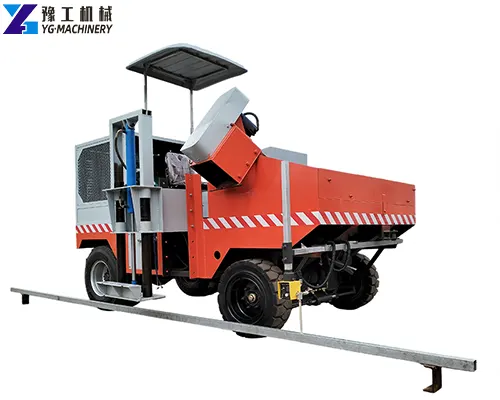
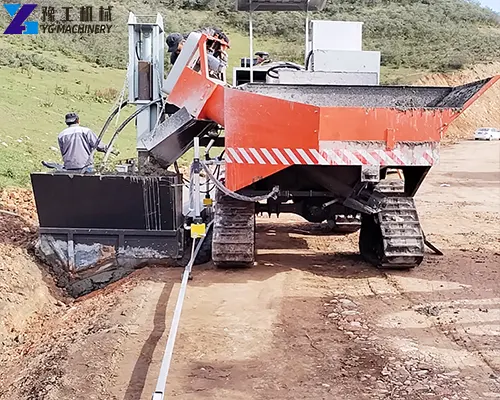
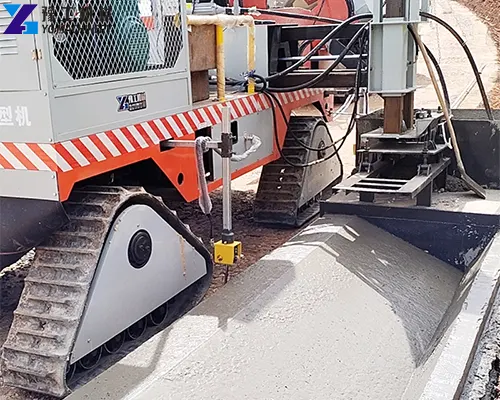
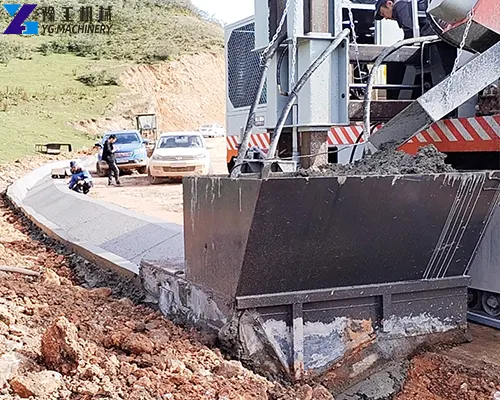
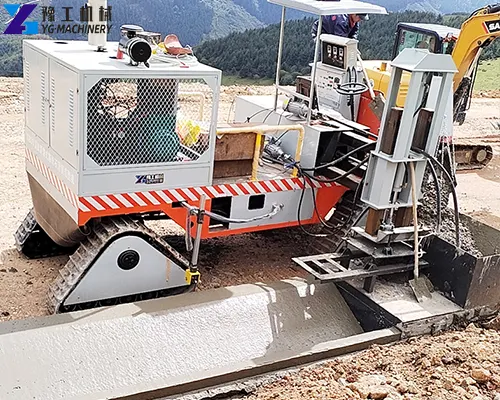
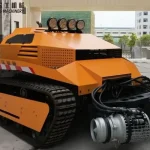
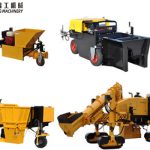
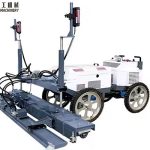
In highway and municipal infrastructure projects, kerbs serve as both safety barriers along road edges and crucial components of drainage systems. Traditional precast block installation or on-site formwork casting methods generally suffer from drawbacks such as numerous procedures, heavy reliance on manual labor, noticeable joints, and difficulty in controlling the road’s alignment. A kerb laying machine, also known as a concrete curb machine or curb slipform machine, addresses this issue. Its core function is to feed mixed concrete into a molding die via a screw feeder system, where it is continuously extruded and shaped under high-frequency vibration and compression. Simultaneously, the machine moves forward on its own, achieving continuous construction with “forming while moving.”
The biggest difference between this and traditional methods (precast block transportation and installation / on-site formwork casting) is that slipform technology eliminates the need for formwork and waiting for curing and demolding. Wherever the equipment moves, a complete and continuous concrete curb is created. This technology has become the mainstream method for road construction in developed countries in Europe and America, and is rapidly gaining popularity in emerging infrastructure markets such as China, Southeast Asia, the Middle East, and Africa. Contact us now for more product information.
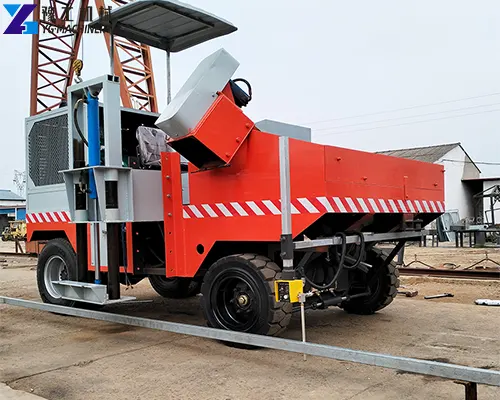
The deadweight is greater, the crawler grip is raised, the construction stability is improved, the climbing and sliding formwork flatness is improved, and the slope is free from interference from external factors
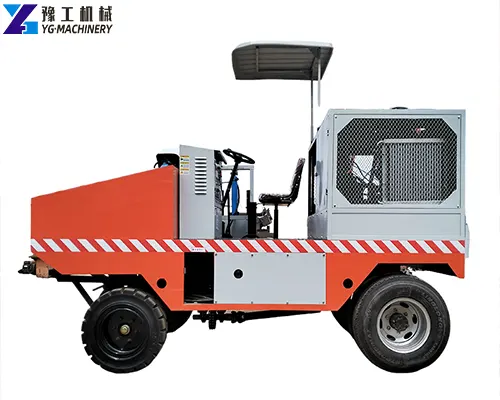
Inline 4-cylinder turbocharged diesel engine (for high altitude areas, increased power output)
Operating voltage
AC380v
Startup form
Electric start
Rated speed
1500rpm
Heat dissipation form
Water cooling
Molding method
High-frequency vibrator (suitable for plastic concrete)
Formed shoulders and side ditches have higher strength
Attached vibration motor (suitable for dry, hard concrete)
Can be paved with curbstones and higher curbstone heights
Automatic leveling system (imported DLS, optional)
Leveling range ±40mm
Imported components, temperature compensation, overvoltage, and overcurrent protection
Steering form
Dual automatic steering system (imported DLS, standard)
Imported components, temperature compensation, overvoltage, and overcurrent protection
Manual steering wheel (hydraulic steering gear)
Minimum turning radius
6800mm
Paving and transfer speed
1m-10m/min
Frequency conversion speed regulation can achieve a wide range of stepless adjustment of paving and transfer speed
Travel drive form
Full-time four-wheel drive
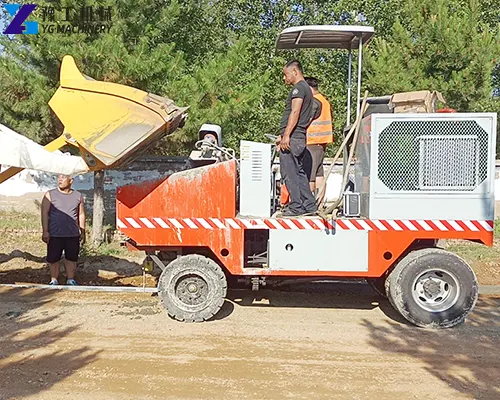
When the road slope is ≤5%, a fully loaded 15m3 tank truck can be used for construction, and the slipform machine connection construction can be realized.
Screw feeder drive type
High-torque hydraulic gerotor motor
To ensure the continuous feeding of concrete, the screw feeder will not be stuck by large stones, and the concrete will be mixed twice to improve the workability of the concrete.
YG curbstone slipform machine supports customized models; inquiries are welcome.
In Which Engineering Scenarios Are Curb Slipform Pavers Used?
Highway and Class I highway curb construction. Long distances and high traffic volumes are characteristics of highway projects, where the continuous operation advantage of curb slipform pavers is maximized. From curbs to medians, from drainage ditches to crash barriers, one machine can handle the construction of multiple structures.
Municipal roads and city streets. Municipal road projects have many curves, intersections, and complex pipelines, requiring high construction precision and flexibility. The YG slipform paver’s automatic steering system and small turning radius are particularly suitable for these scenarios, allowing for precise laying without damaging existing road surfaces and pipelines.
Urban expressways and BRT corridors. BRT (Bus Rapid Transit) corridors have extremely high requirements for the linear accuracy and structural strength of curbs. The overall stability and precision of machine-paved curbs fully meet the high standards of BRT corridors.
Industrial park and logistics park roads. The park’s road construction projects are of moderate scale but diverse in type (curbstones, shoulders, drainage ditches, parking lot edges, etc.). YG’s multi-functional capabilities allow contractors to complete all construction tasks with a single machine, resulting in high equipment utilization.
Residential and commercial real estate supporting facilities. For scenarios such as internal roads, landscaped roads, and parking lot edges, the project volume is relatively small, but high aesthetic requirements exist. Slipform construction produces smooth lines and a glossy surface, significantly enhancing the project’s perceived quality.
Rural roads and rural road hardening. Under the “Village-to-Village Road Construction” project and rural revitalization initiatives, a large number of rural roads require supporting curbstones and drainage ditches. Slipform machines offer fast construction speed and low cost, making them ideal for large-scale rural road network construction.
Airport runway and apron edges. Airport projects have the most stringent requirements for construction precision and structural strength. Heavy-duty slipform machines can handle the construction of high-standard concrete structures such as airport runway edge stones and guide walls.
Farmland irrigation and water conservancy projects. Besides curb stones, slipform liners can also be used for lining farmland irrigation and drainage ditches by changing the channel molds. They can slipform concrete on-site into U-shaped or V-shaped channels, achieving an efficiency several times that of manual lining.
YG curb stone slipform liners have been exported to more than 80 countries and regions, including the United States, Australia, the United Arab Emirates, Saudi Arabia, South Africa, Brazil, Thailand, the Philippines, Indonesia, Vietnam, Poland, Germany, and Spain, and have proven successful in various climates and geological conditions worldwide.
High (repeated wear and tear on timber/steel formwork)
Applicable Scenarios
Suitable for long distances, large projects, and projects with high alignment requirements
Small-scale repairs, miscellaneous projects
Irregular structures, areas where slipforming is not possible
Weather Impact
Can be operated in light rain, quick recovery after rain
Basically unaffected (installation stage)
Significant impact from rain, long waiting time for formwork removal
Equipment Investment
Higher (disposable)
Low (only tools and crane required)
Low (formwork + tools)
Long-Term Maintenance Costs
Low (good integrity, not easily damaged)
High (seams prone to settlement and damage)
Medium
Conclusion: When the project length exceeds approximately 3-5 kilometers, the overall cost of slipform construction is already lower than that of traditional methods; the longer the project, the more pronounced the advantages of slipform. Precast blocks can still be used for small, sporadic repairs, but slipform technology is the trend for medium- to large-scale projects.
Frequently Asked Questions about Curb Slipform Machines
Q1: Which is more cost-effective: a slipform paving machine or precast curbs?
A1: It depends on the project size. Generally, for a single project with curb lengths exceeding 3-5 kilometers, the overall cost (labor + materials + construction time) of slipform paving with a concrete curb machine is lower than that of precast block installation. The longer the project, the more pronounced the advantages of slipform paving. According to industry data, slipform paving can save 60% of labor, reduce material waste by 25%, and shorten the construction time by 3-5 times.
Q2:What shapes of concrete structures can a curb slipform machine make?
A2: By changing the molds, a slipform paving machine can construct various cross-sections, including upright curbs, flat curbs, L-shaped curbs, shoulders, drainage ditches (U-shaped/V-shaped), small crash barriers, median strips, and landscape curbs. Custom molds are available; basically, any shape with a continuously extruded cross-section can be produced.
Q3: What skills are needed to operate a slipform paving machine? How long does it take to learn?
A3: No special qualifications are required, but some basic mechanical operation skills and concrete construction knowledge are necessary. YG provides on-site training. Operators with no prior experience can generally work independently after 1-2 days of hands-on practice. Those with excavator or paver operating experience will learn even faster.
Q4: Can slipform pavers be used for curb construction during the rainy season and winter?
A4: Slipform pavers can operate normally in light rain and are much less affected by weather than traditional formwork methods. Work must be stopped during heavy rain, but can resume 2-4 hours after the rain stops (traditional methods require waiting for the formwork and foundation to dry, which takes longer). Winter construction requires insulation and antifreeze measures. Construction is not recommended when the ambient temperature is below 5℃, or antifreeze agents should be added, and curing should be strengthened.
Q5: What is the strength of slipformed curb stones?
A5: Under normal construction conditions, the 28-day compressive strength of slipformed curb stones can reach 30-40 MPa, depending on the concrete mix ratio and curing conditions. High-frequency vibration achieves a compaction degree of over 98%, higher than the 85%-90% of manually poured curbs. The continuous, seamless monolithic structure also gives it superior impact and settlement resistance compared to precast blocks.
Q6: How are spare parts and after-sales services handled overseas for YG machines?
A6: YG Machinery exports to over 80 countries and has established a comprehensive global spare parts supply system. Commonly used wear parts (vibrator oil seals, filters, belts, mold liners, etc.) are kept in stock and shipped directly via international express, reaching most countries within 3-7 days. Technical support is provided remotely via WhatsApp/WeChat video calls, and on-site service by engineers can be arranged for major issues. The entire machine comes with a one-year warranty and lifetime technical support.